
Post-funding cofounder conflict often surfaces when investment accelerates hiring, board scrutiny and high-stakes decisions. A monthly cofounder relationship reset gives founders protected time to address tensions before they disrupt growth.
You did it. The term sheet is signed, the wires have cleared, and the celebratory drinks are behind you. Behind that milestone, however, post-funding cofounder conflict can begin quietly as pressure, expectations and decision-making accelerate. After months of grueling pitch-deck iterations, sleep-deprived product sprints, and surviving on nothing but adrenaline, your bank account is finally armed for growth.
First, congratulations. Securing venture backing is a massive achievement. It is a testament to your vision, your scrappiness, and the sheer volume of personal sacrifice you and your cofounders have poured into this company. You have survived the grueling zero-to-one phase, and you deserve to celebrate that milestone.
But now, it is time for an uncomfortable, multi-million-pound reality check: the real work has only just begun.
Many founders believe that raising capital is the ultimate validation, a shield that solves operational and personal friction. In reality, funding is an accelerant. It doesn’t just scale your product, your server capacity, or your headcount; it scales the hidden, hairline cracks in your cofounder relationship.
When you were a lean team of two or three operating in a cramped room, you could align over a quick coffee. But as you scale, the informal, “we’ll just figure it out” model of relationship management collapses under the weight of board pressure, hiring targets, and burn rates.
Why Cofounder Conflict Intensifies After Funding
If you think your relationship is immune to these pressures, you are ignoring the data. But let’s look past the generic “startup failure” clichés and focus on the cold realities of scaling:
- Conflict is common: Friction is not a sign of a bad partnership or failed system. It is a predictable consequence of growth when two or more people navigate extreme uncertainty under pressure. Mark Macleod in his podcast The Startup COE Show said 100% of cofounders experience conflict. Disagreement is inevitable; unmanaged conflict is not.
- The “Wrong Team” Diagnostic: When CB Insights analyzed hundreds of venture-backed startup failures in their post-mortem data, they discovered that 23% of failures are directly caused by “Wrong Team” dynamics. This rarely means a lack of technical or operational competence. Instead, it represents cofounder misalignment—unvoiced strategic disagreements that freeze execution, divide employees, and bleed capital while the company stalls in gridlock.
- The Premature Equity Trap: Does this feel familiar? Harvard Business School and Carta data show that 73% of founding teams finalize their equity split within the very first month of working together. You divided the pie when the stakes were low and the future was a vague sketch. – Now, ask yourself honestly: Did your last funding round really go as fairly as you wanted? Or did those cap table negotiations quietly leave a lingering trace of unvoiced resentment, where one partner feels they are carrying 80% of the weight for 50% of the reward?
If you don’t build a dedicated, structured “conflict infrastructure” to handle these brewing tensions, they will not disappear. They will quietly rot your company from the inside out.
Signs of Cofounder Conflict After Funding

In the early stages of scaling, relationship breakdown rarely announces itself with an explosive, door-slamming shouting match in the boardroom. Instead, it begins with unmanaged drift—a slow, silent slide where partners bite their tongues to “keep the peace” and preserve momentum.
This is what we call the Resilience Trap: quietly picking up a partner’s dropped balls, tolerating minor delays, or ignoring unaligned behavior to maintain an artificial, polite facade.
But relationship science and neuroscience prove that your nervous system registers this emotional drift long before your conscious mind can process it. To protect your company, you and your partner must learn to run an active diagnostic scan across three distinct stress radars:
Radar 1: The Somatic Warning Signs (The Body’s Warning Memo)
- The Somatic Knot: A sudden, heavy knot in your stomach when weekend Slack pings hit your phone, or “Sunday dread” returning to your weekly routine.
- Physical Restriction: Tightening jaws, shallow breathing, stiff shoulders, or an accelerated heartbeat during standard operational syncs.
- The Cognitive Shutdown: When you feel relationally unsafe, your brain floods with cortisol, putting your nervous system into a defensive posture. In this state, your prefrontal cortex—the seat of strategic logic, financial planning, and creative problem-solving—goes entirely offline. You physically and biologically cannot make sound, high-level strategic decisions when your body is locked in a survival-driven fight-or-flight response.
Radar 2: The Behavioral Warning Signs (The Drift to Silence or Violence)
When relationship stress mounts, founders lose their “dual-processing” ability—they get so caught up in what they are arguing about that they go completely blind to how they are acting. Watch for these shifts in behavioral patterns:
- The Drift to Silence: Hiding stress by turning webcams off during remote syncs, taking unusually long to reply to direct Slack messages, or communicating strictly through passive-aggressive sarcasm.
- The Slide to Violence: Speaking in sweeping, defensive absolutes (“you always do this” or “we never do that”), interrupting, controlling the floor, and turning strategic debates into a personal battle to “win.”
- The Lethal Stonewall: The ultimate danger sign occurs when a partner “turns to stone”—becoming completely still, silent, and emotionally inaccessible during a meeting. While the stonewaller does this to numb their own overwhelming stress, the other partner registers this absolute emotional absence as a terrifying threat, triggering a vicious cycle of white-hot pursuit and icy withdrawal.
🧠 Radar 3: The Narrative Warning Signs (The Loss of Curiosity)
When partnerships are healthy, conflict is fluid and characterized by curiosity. When partnerships are under toxic stress, the narrative becomes rigid, simple, and stagnant.
- The “Idiot-Driver” Reflex: You begin attributing your partner’s operational mistakes to intrinsic character flaws (“they are lazy, incompetent, or checked out”), while explaining away your own execution errors strictly by external scaling circumstances (“I was busy, short-staffed, or under board pressure”).
- The Loss of Wonder: You stop asking questions and start only advocating. You feel a rigid, righteous certainty that your version of events is the only objective “truth” in the room.
- The Dark Glimmer: Experiencing a quiet, secret flash of satisfaction or vindication when a project your cofounder championed hits a bump or fails, simply because it proves you were “right.”
How to Run a Monthly Cofounder Relationship Reset

If you spot any of these indicators on your radars, a casual Friday afternoon pint is not the only thing that is going to save you. In fact, unstructured social outings almost always fail because they inevitably default back to pipeline tracking, hiring blockages, and the very operational stressors you are trying to escape.
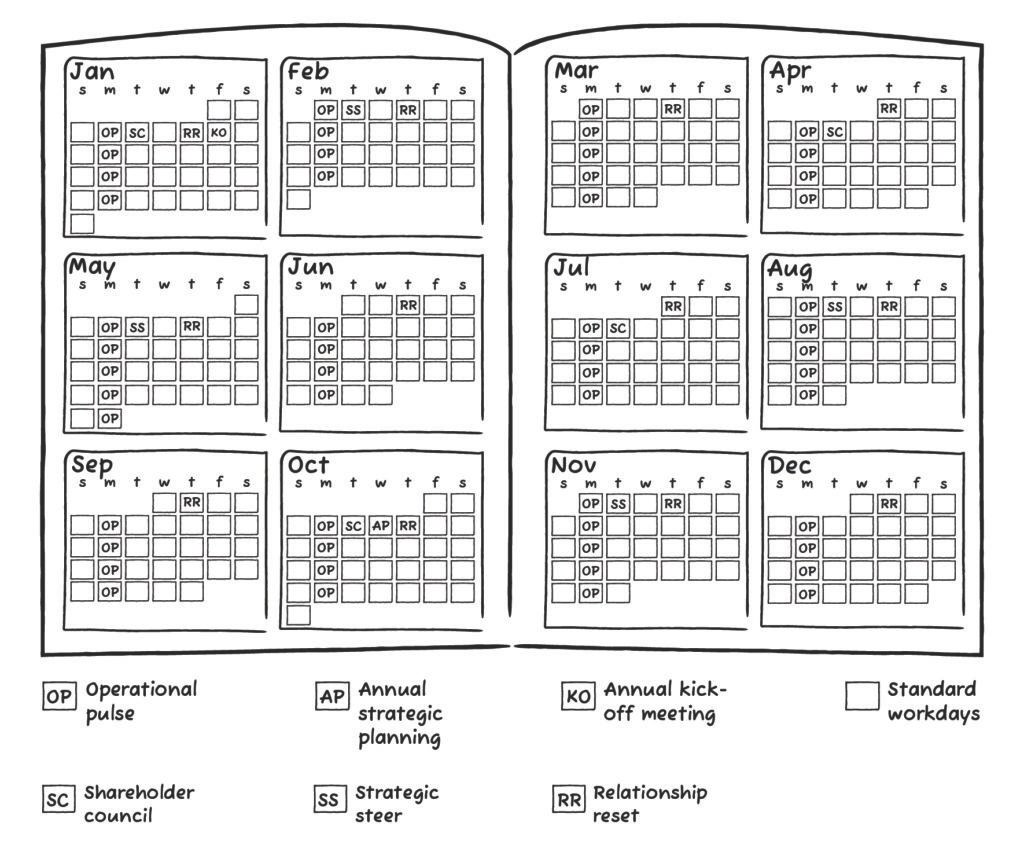
To survive the scaling storm, you must install a structured calendar sanctuary: The Relationship Reset (RR), a monthly anchor of The Partnership Pulse™ Protocol.
The core philosophy of the protocol is simple:
Culture isn’t what you say you value. It’s what you put in your calendar. – Jane Hales
The Relationship Reset is a structured, ‘contractually’ protected 90-minute monthly meeting. In this space, you put on your “Human” Hat. There is absolutely zero business talk allowed. You step entirely out of operational management to actively manage your relationship, restoring the “Emotional Contract” between you.
The Relationship Reset: A Modular, High-Performance Agenda
Below is a modular template you can adopt immediately. While the timing and sequence are structured, you should aggressively customize the elements to reflect your own team’s personalities, humor, and quirks. It’s your time to work on the relationship, not just be in it.
Block 1: The Bid Audit (20 Minutes)
- The Science: Relationship researchers such as John Gottman have proven that the difference between thriving and failing bonds lies in how partners respond to “bids for attention”—the subtle, everyday moments where one partner reaches out for support, validation, or a brief pause. In highly successful partnerships, these bids are acknowledged and validated 86% of the time. In failing ones, that number plummets to 33%.
- The Practice: Look back at the last 30 days. Where did you miss or ignore your partner’s bid for support? Celebrate the moments where you had each other’s backs, and intentionally clear any minor “nicks in the bond” before they calcify into unvoiced resentment. Where do you need to give performance feedback, the kind you’ve given to a staff member?
Block 2: The Personal Load Share (30 Minutes)
- The Science: Executive coach Jerry Colonna famously challenges leaders to ask: “How are you, really?”—not as a polite greeting, but as a genuine bridge of self-inquiry. Sharing your internal landscape prevents your partner from misinterpreting your stress-induced behavior.
- The Practice: Share the personal loads you are carrying outside the office—sleep deprivation, relationship friction at home, family pressures, or physical burnout. Use your personalized “Guide to Me” Operating Manual to remind your partner: “Here is what I look like when I am red-lined, and here is how you can support me without triggering my defenses.”
Block 3: The “Begin Anew” Ritual (20 Minutes)
- The Science: This ritual is inspired by Zen master Thich Nhat Hanh’s practice of “Beginning Anew,” used by history’s most resilient global leadership teams to clean the slate and keep emotional accounts balanced.
- The Practice: Take turns expressing genuine, specific appreciation for each other’s character (e.g., “I deeply admire your courage when dealing with that board dispute”—not just “thanks for finishing the slide deck”). Then, gently voice any minor regrets or things you wish you had handled differently over the past month.
Block 4: Personality-Driven Play (20 Minutes)
- The Science: Play breaks down the rigid, professional armor that keeps your brains in a defensive posture. It humanizes you and reminds you why you chose to build this company together in the first place.
- The Practice: Introduce a lighthearted, recurring play ritual to deflate boardroom egos. For example:
- The Joke Ledger: Keeping a running record of the most ridiculous, catastrophic stories you both made up under stress during the month, and reading them aloud to laugh at your own reactive minds.
- The “Ego Jar”: Put £50 in a jar every time one of you insists on “winning” an argument that had zero material impact on the company’s KPIs.
- The Disruption Word: Establish a funny, absurd safe-word (like “dotysofus”—Don’t Take Yourself So Seriously) that either partner can use to instantly pause a mounting strategic argument when it starts turning personal.
- Make it yours: If you are both competitive, play a rapid-fire game of ping-pong. If you are creative, draw terrible 60-second caricatures of your board members. Design something that fits your collective personality.
Put Cofounder Alignment in the Calendar

The Relationship Reset is just one vital piece of a much larger, high-performance machinery. To truly remove ego from the boardroom, protect your equity, and build a highly sellable asset, you need a comprehensive governance map that separates your operational execution from your high-level asset decisions.
In our upcoming book, The Distance Between Us: Rebuilding Cofounder Trust or Ending the Partnership with Dignity, we detail the complete Partnership Pulse™ Protocol. We break down the other three critical, protective meetings every venture-backed team must install immediately after funding:
- The Shareholder Council (Quarterly): Where you wear the “Owner” hat to negotiate personal deal-breakers and long-term equity plays without daily operational noise.
- The Strategic Steer (Quarterly): Where you wear the “Director” hat to fiercely debate corporate budgets and risk registers behind closed doors—while maintaining a 100% united front in public.
- The Operational Pulse (Weekly): Where you wear the “Manager” hat to keep execution fast, focused, and completely stripped of emotional, high-level strategic distractions.
Is cofounder tension already affecting decisions, communication or energy?
Download the Partnership Barometer to identify where alignment is weakening before it becomes a business risk.
Don’t leave your venture’s survival to emotional coincidence. Take control of your co-founder dynamics before the pressure of scaling takes control of you.
If you don’t fix your problem before you scale, you scale your problem. If you need help setting it up, speak to me.
Learn how to build a Bulletproof Partnership. Pre-order your copy of The Distance Between Us today, and download our free, interactive Partnership Barometer to score your team’s alignment.