
Most cofounders start out as a dream team. You share a big vision, late-night planning sessions, and the sense that you’ve finally found “your person” in business. Over time, that energy often shifts into friction, misunderstandings, and unspoken resentment that can threaten both the company and the relationship.
The Partner Hype Cycle is a simple way to understand the predictable stages cofounder relationships move through – from euphoria to disillusionment and, if you do the work, to a mature partnership. It gives you a shared map so you can see where you are now and what to do next, instead of wondering “how did we get here?”.
What is the Partner Hype Cycle?
The Partner Hype Cycle borrows the idea of a “hype cycle” – the journey from inflated expectations to reality and then to sustainable value – and applies it to cofounder relationships. Instead of tracking new technologies, you track the emotional and practical arc of your founding partnership.
For most cofounders, the cycle looks something like this:
- Stage 1: Honeymoon Period – Formation & euphoria
- Stage 2: Peak of Inflated Expectations – Overconfidence & over commitment
- Stage 3: Trough of disillusionment
- Stage 4: Slope of enlightenment – Realignment & renegotiation
- Stage 5: Plateau of Productivity – Mature partnership (or structured breakup)
You might move through these stages more than once as your startup grows. The key is to recognise the signs early, so you can make intentional choices rather than being dragged along by unspoken expectations and old habits.
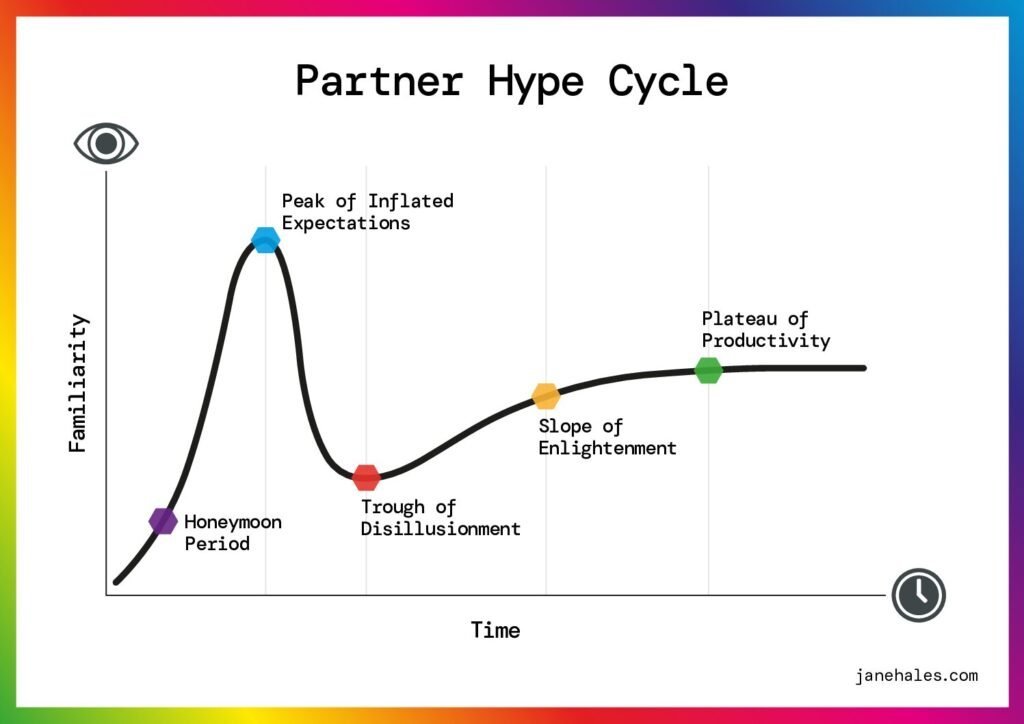
Stage 1: Formation & euphoria – “we’re a dream team”
In the early days, everything feels possible. You’re energised, aligned on the big picture, and full of ideas. You talk about “our baby”, you move fast, and you instinctively trust each other.
Typical signs of Formation & euphoria:
- You assume you’ll “figure everything out together” and avoid “heavy” conversations about equity splits, exits, or worst-case scenarios.
- Roles are fuzzy – you just do whatever needs doing and it feels fine.
- You get positive feedback from friends, early customers, or mentors that reinforces your belief that this partnership can do anything.
The risk at this stage is that you confuse good chemistry with good structure. You rely on friendship and shared enthusiasm, rather than putting in place clear agreements about decision rights, responsibilities, and money. Many of the blow-ups that happen later are actually seeds planted here.
To make the most of this phase:
- Capture why you chose each other – strengths, values, ways of working – so you can come back to it when things get harder.
- Schedule time for the “unsexy” conversations (equity, exits, decision-making, conflict) while you still like each other and before there is a specific problem on the table.

Stage 2: Overconfidence & over commitment – “we can do it all”
Successes start to come in – customers, revenue, maybe investment. Your calendar fills up, your to-do list explodes, and you say yes to almost everything because it all feels important.
Signs you’re in Overconfidence & over commitment:
- Both of you are “always on”, working late, juggling many bets at once.
- One or both of you quietly feel you’re carrying more of the load, but you don’t want to sound petty.
- You rarely stop to ask “what should we stop doing?”; the only direction is more
Here, silent scorekeeping becomes dangerous. You start mentally tracking how many late nights you’ve done, whose work is more visible, or who sacrificed more. If you don’t talk about it, small resentments build and will fuel the next stage.
To navigate this phase:
- Have explicit conversations about capacity and priorities: what gets dropped if everything doesn’t fit.
- Check in regularly on perceived contribution and recognition – not just on performance, but on how appreciated each of you feels.
Stage 3: Trough of disillusionment – “this is harder than I thought”
At some point, the gap between the idealised partnership and the daily reality becomes too big to ignore. Revenue might be lumpy, the team is growing, and the weight of responsibility feels heavier. You may find yourself thinking, “I didn’t sign up for this version of us”.
Signs of the Trough of disillusionment:
- You replay old arguments in your head and find it harder to give your cofounder the benefit of the doubt.
- Certain topics feel “off limits” because they always lead to a fight or a shutdown.
- You feel unseen or unfairly treated – for your effort, your judgement, or your sacrifices.
- One or both of you starts imagining a Plan B (changing your role, or leaving) without saying so out loud.
Psychology and founder research show that unspoken resentment and misaligned expectations are at the heart of many cofounder conflicts, often long before any formal dispute. The danger here isn’t just the arguments; it’s the avoidance – decisions that never get made, risks that never get openly named, emails that go unanswered because the topic feels too loaded.
To move through this stage instead of getting stuck:
- Name that you’re in a trough. Simply saying “we’re in a rough patch” can reduce shame and make it easier to work on it together.
- Create a structured “clearing” conversation where each person shares what they’re frustrated about, what they take responsibility for, and what they want going forward.
Stage 4: Realignment & renegotiation – “if we’re going to keep doing this, something has to change”
If you can tolerate the discomfort of the trough, you reach a point where the only options are to change the partnership or end it. This is the Realignment & renegotiation stage – confronting the reality that what worked in year one may not work in year three or year five.

Signs you’re entering Realignment:
- You’re finally having honest conversations about roles, power, contribution, and the future.
- You’re questioning whether titles, equity, or responsibilities still reflect reality.
- You’re open (even if nervous) about bringing in external support – a coach, mediator, or trusted adviser.
This stage is often messy and emotional, but it’s also where a deeper, more sustainable partnership becomes possible. Instead of pretending everything is fine, you design something that works for who you both are now and what the business needs.
To work well in this phase:
- Separate the person from the role: one founder stepping back from a role doesn’t mean they’ve “failed” as a cofounder.
- Create a safe container for renegotiation – a facilitated session, a structured off-site, or a clear agenda where you agree the goal is “a fair, workable future”, not winning.
Stage 5: Mature partnership (or structured breakup)
If Realignment goes well, you arrive at a Mature partnership: you know each other’s strengths, weaknesses, and triggers and have designed around them. Decision-making is clearer, conflict is less scary, and you have shared rituals that keep you aligned.
Signs of a Mature partnership:
- You have written agreements around equity, roles and decision rights – and you actually use them.
- You can disagree strongly and still trust each other’s intentions.
- You have explicit ways to surface tensions early (regular check-ins, founder-only sessions, off-sites).
For some pairs, the honest outcome of Realignment is a structured breakup: one founder exits or shifts into an investor/adviser role, and the other continues as CEO. Done well, this can save both the business and the relationship.
Here, the work is to:
- Keep updating your agreements and rhythms as the business evolves. A “mature partnership” is not a static state.
- Normalise role changes and exits as part of healthy growth, not as failure.
How to use the Partner Hype Cycle with your cofounder
Understanding the stages is helpful, but the real value comes from using the Partner Hype Cycle as a shared tool. Here’s a simple process you can follow together.
1. Identify your current stage
Sit down with your cofounder and read through the stages. Ask each other:
- Which stage feels most like “home” right now?
- Are there signs of any other stage showing up as well?
It’s normal to see elements of more than one stage, especially during transitions or high stress. The goal is not to “diagnose perfectly”, but to choose the description that best explains your current tensions and patterns.
2. Name your biggest risks and patterns
Once you’ve picked a stage, ask:
- What are the biggest risks for us at this stage?
- What patterns are we seeing – avoidance, scorekeeping, constant overwork, quick escalation?
For example:
- In Formation & euphoria, your risk might be avoiding hard conversations about equity.
- In over commitment, it might be burning out while resenting each other.
- In the Trough, it might be quietly planning exits instead of addressing issues.
Writing these down makes them feel less like personal failings and more like challenges you can tackle as a team.
3. Choose three next steps for the next 30–90 days
To turn insight into action, agree on just three practical moves:
- One conversation you’ll definitely have
- Example: a structured conversation about perceived contribution and recognition.
- One ritual you’ll start or restart
- Example: a monthly founder-only check-in where the agenda is “the business” for the first half and “the partnership” for the second half.
- One boundary or change you’ll test
- Example: redefining who owns which decisions, or agreeing to say no to certain types of work or deals.
Treat these as experiments, not permanent fixes. Pick a date to review how each change has gone and what you’ve learned.
4. Consider external support early, not late
Many cofounders only ask for help when they’re already close to legal action or one person has emotionally checked out. Research and practitioner experience suggest that earlier intervention – via coaching, mediation, or even a trusted peer – leads to better outcomes and less damage.
Ask yourselves:
- If we keep doing what we’re doing for another 12 months, where are we likely to end up?
- What support would we ask for if pride and embarrassment were not in the way?
Sometimes a single facilitated conversation or off-site can unlock months of stuckness.
Why understanding the Partner Hype Cycle matters
Cofounder relationships are one of the most powerful assets in a startup – and one of the most common points of failure. When you don’t have language for what’s happening between you, it’s easy to feel uniquely broken or to default to blame.
The Partner Hype Cycle normalises the ups and downs. It shows that:
- Feeling frustrated or disillusioned doesn’t automatically mean the partnership is over. It might mean you’re due a renegotiation.
- Mature partnerships are designed, not accidental – they require explicit agreements, decision systems, and ongoing care.
- Sometimes, the bravest and kindest choice is a structured exit rather than an endless, draining stalemate.
By using this framework, you can see your relationship as something you work on together, not something that just “happens to you”. That shift alone can reduce conflict, speed up decisions, and give your startup a much better chance of thriving.
If you’re an equal cofounder team and you recognise yourselves in any of these stages, this is a powerful moment to pause, talk, and design your next chapter – on purpose.
Checkout how Anna, Lionel and Krish at the Cattalyst Collective meet and cope with the Partnership Hype Cycle in my book The Distance Between Us