
Greg Brockman probably didn’t picture a jury poring over his private thoughts when he opened his notebook back in 2017.
He was doing what many founders do at 11:47 p.m. on a Sunday: thinking about the future, the money on the line, and the cost of big decisions. One entry wrestled with a simple question: “Financially, what will take me to $1B?” It was a mix of aspiration, anxiety, and raw honesty about whether to break with Elon Musk and pivot OpenAI away from a pure nonprofit path.
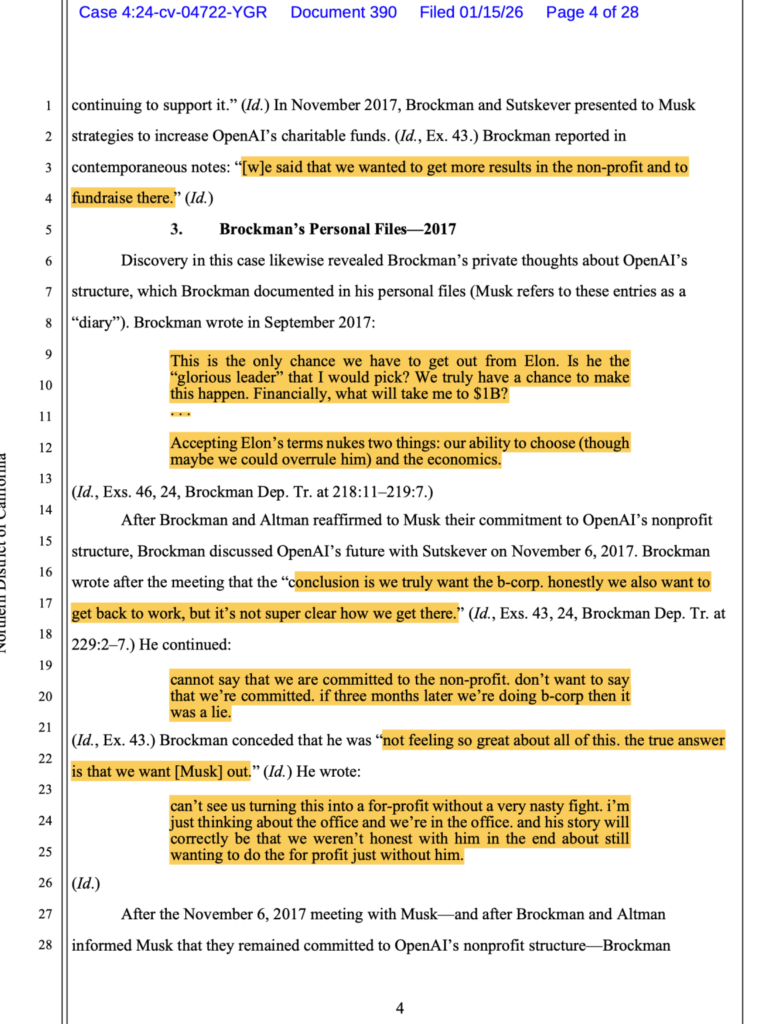
“Some chance that rejecting Elon will actually lose us Sam. We’ll find out tomorrow if doing an override all the way through is palettable,” the diary read. “This is the only chance we have to get out from Elon. Is he the ‘glorious leader’ that I would pick?” – Sam Brockman
Years later, that diary page sat in the middle of one of the most closely watched tech trials on the planet. ABC7 News called Brockman’s journals “key evidence,” saying Musk’s legal team argued they showed executives “misled Musk about maintaining OpenAI as a nonprofit organization.” Business Insider noted that more than 100 documents — “texts, emails, and even diary entries” — from top tech figures were unsealed, offering a rare look into “how billionaires really talk when they think no one’s watching.”
For cofounders in normal‑sized companies, that is the real wake‑up call. Not the billions at stake. Not the AI drama. The fact that your private reflections, Slack threads, and late‑night emails can become the script other people use to tell your story.
This piece is about how to stop that script turning into a horror show.
When your “inner voice” becomes Exhibit A
Journalists didn’t lead with the statute of limitations, the case law, or the finer points of nonprofit governance.
They led with the diary, the texts, and the contradictions. Business Insider highlighted diary snippets where Brockman weighed the pros and cons of “rejecting Elon” and asked whether Musk was really the “glorious leader” he wanted. ABC7 emphasised entries where he calculated potential personal upside from OpenAI’s shift, framing them as central to Musk’s fraud theory.
Others zoomed out. One tech outlet wrote that the unsealed filings revealed “a toxic mix of ego and ambition” driving the feud, built from emails, messages and journal entries that showed “a bitter, deeply personal battle for control over the future of AGI.” The Washington Post branded the trove “unflattering secrets” that exposed Silicon Valley’s inner workings, while social posts summarised it more bluntly: “cringey texts, emails and private diary entries” from Musk, Altman and their circle.
“I think Jeff is a bit of a tool and Satya is not, so I slightly prefer Microsoft, but I hate their marketing dept,” Musk wrote.
None of this is unique to OpenAI. It’s what happens whenever a founder relationship breaks down under the spotlight:
- private doubts become public “gotchas”
- thought‑process notes are treated as confessions
- early sketches of intent are held up as binding promises
For most mid‑size cofounders, the stakes are smaller but the pattern is similar. You think you’re making sense of your own head. A court — or a journalist — thinks you’re making a statement.
The narrative penalty: how others read your messages
Once the documents dropped, commentators started stitching them into a story.
A Vanity Fair contributor described Brockman’s diary as “getting to the heart of everything that Elon is claiming here,” pointing to years of inner debate about moving from nonprofit to for‑profit, and how much he personally might gain. On social platforms, one commentator said the dump of private texts, diary entries and emails was “exposing both men as petty, obsessed, and way less ‘genius mastermind’ than the myths they’ve sold us.”
In other words, the messages weren’t just taken literally; they were used to answer three loaded questions:
- Are you honest?
- Are you consistent?
- Are you in this for the mission or the money?
The Washington Post put Altman’s credibility under the microscope, asking whether former colleagues might see him as misleading, and linking that question to the diary and email record on the stand. Another piece noted that the documents showed OpenAI’s leaders “recognising the tension between public benefit and private profit while still pushing ahead,” inviting readers to judge not only what they did, but how they felt about it.
That’s the narrative penalty of messy internal comms. Even if you never expect to see a courtroom, the same logic applies when staff, investors or the press get partial access to your Slack or email history:
- a single venting message stands in for your whole attitude
- a private thought is treated as your final position
- a moment of self‑interest outweighs years of principled behaviour
The lesson isn’t “never write anything real.” It’s “know which channel is for processing, which is for deciding, and which is for recording the story you’re actually prepared to stand behind.”
Processing vs record‑keeping: you need both, not mashed together
Founders need somewhere to be unvarnished. You carry pressure, risk, responsibility and fear that you can’t always offload onto your team.
Journalling, voice notes and private drafts are often how you metabolise that load. The problem in Musk vs Altman wasn’t that people had diaries; it was that those diaries blurred the line between self‑therapy and company record. When a judge quotes your late‑night reflection on “what it would take to get to $1B” as evidence of intent, you’re seeing that blur in action.
For mid‑size cofounders, a healthier pattern looks like this:
- Processing spaces: private journal, therapist, coach, or trusted mentor where you can say the unsayable, explore ugly thoughts, and name fears without them turning into corporate history.
- Decision spaces: structured meetings where you come back with a clearer head and turn those insights into explicit agreements or questions.
- Record‑keeping spaces: follow‑up docs and emails where you summarise what you decided in language you could live with if it appeared on the front page.
Your Partnership Pulse™ Protocol is a ready‑made map for this separation:
- The Relationship Reset is where you wear your Human hat and bring the emotional load. This is the part that will absolutely leak into your diary if you don’t surface it. You talk about what energy you’re bringing, what you’re worried about, and what you need from each other, without trying to fix the entire business.
- The Shareholder Council is where you pull the biggest themes from those reflections into conscious decisions about ownership, exits, and deal‑breakers. These are the things courts actually care about.
- The Strategic Steer and Operational Pulse keep the day‑to‑day from becoming a proxy war for deeper resentments by giving tactics, risk and performance their own lanes.
Used well, that rhythm lets you pour emotions into the right container, then convert what matters into explicit, mutual commitments.

“Always Be Contracting”: keeping your story and your documents aligned
One reason the Musk vs Altman materials are so explosive is that they capture evolving intent without matching updates in the formal agreements.
Brockman’s diary, for example, reportedly tracks his internal dialogue about moving away from Musk, shifting structures, and the personal upside of a new path. At the same time, Musk points to earlier promises about OpenAI’s nonprofit mission, arguing that any later pivot was a betrayal. The court has to decide which version of the story is binding. Is it the early emails, the later diary, or the formal documents? Real data not stories in your head.
For cofounders, this is where “Always Be Contracting” matters. It doesn’t mean lawyering every Slack or Teams thread. It means:
- treating each major shift, for example new investor, new structure, new product line, new power dynamic — as a trigger to re‑state what you’re agreeing to, in plain language
- capturing that agreement in the appropriate forum: Shareholder Council minutes, updated shareholders’ deed, side letter, or written founder pact
- making sure your day‑to‑day messages don’t contradict the agreements you say you’re living by
When your internal communications and your formal contracts tell the same story, discovery during a trail is less scary. The paper trail reinforces your narrative instead of shredding it.

“i remember seeing you in a tv interview a long time ago (maybe 60 minutes?) where you being attacked by some guys, and you said they were heroes of yours and it was really tough,” Altman texted Musk in February 2023. “well, you’re my hero and that’s what it feels like when you attack OpenAI.”
When they drift, you’ve handed any future lawyer or journalist all the material they need to write a “gotcha” piece. And this is how it might look…
Designing messages that age well
You can’t future‑proof every sentence you write. But you can design your overall communication habits to age better.
The Musk vs Altman coverage suggests a few practical guidelines:
- Assume screenshots.
More than one journalist described the trove as “text messages, emails, and journal entries…unsealed” and served up to the world. Writing as if screenshots will be read by a stranger in three years tends to clean up the worst. - Name your hat.
Before sending a heated message, consider: am I speaking as an Owner, a Director, a Manager, or a Human? Mixing those hats in one thread is where things get messy. The Partnership Pulse™ Protocol exists to give each of those voices its own room. - Move from venting to summarising.
It’s fine to vent in your personal journal. What matters for the company record is the follow‑up summary: “Here’s what we discussed, here’s what we decided, here’s what we’ll revisit.” That’s the email you want a judge to see. - Keep values and concerns together.
Journalists loved lines that separated the two: diary entries about personal wealth on one page, and public statements about “benefiting humanity” on another. As a founder, you can integrate them: “Here’s what we want for the world, here’s what we want for ourselves, here’s how we’ll balance that.” - Use “Always Be Contracting” as a filter.
Before you hit send on anything big, ask: does this reflect the agreement we think we’re in? If not, it’s a signal to go back to the Shareholder Council and re‑contract explicitly.
These aren’t about being bland. They’re about aligning your internal story with the external one you’ll be judged on later.
How PR teams can help founders long before a crisis
Musk vs Altman also shows how much “crisis comms” actually happens years before any official crisis.
When a Washington Post piece talks about “unflattering secrets” and “questions about honesty,” it’s drawing on a decade of documents, not a single press release. A Wall Street Journal feature on the “juiciest evidence” sifts through testimony and messages to explain “how billionaires ended up in a courtroom,” not just why a jury ruled one way.
For PR teams working with founder‑led companies, that suggests a different role:
- From press release machine to narrative coach.
Encourage founders to see every major email, board pack and investor update as part of the long‑term story. Help them find language that’s honest and coherent over time. - From crisis fire‑fighter to early‑warning system.
When you see private comms that clash with the public brand, for example sharp comments about each other, cynicism about mission, resentment about equity — treat that as a signal. It’s not your job to fix the relationship, but you can nudge leaders towards a Relationship Reset conversation instead of letting the resentment seep into everything. - From spin doctor to translator.
Good PR can help founders turn diary‑level emotion into constructive, human‑sounding explanations: “We’ve disagreed strongly about X, here’s how we’re handling it, here’s what stays constant.” That makes for healthier internal comms and more believable external ones.
In short, communications aren’t just what you say after something breaks. They’re the soil the relationship grows in.

A simple reset you can start this month
If you’re reading this as a cofounder in a mid‑size company and thinking, “Our WhatsApp history would not look great on a projector,” you’re not alone.
The good news is you don’t have to rewrite history. You only have to change the pattern from today.
Three practical steps:
- Run a Relationship Reset.
Block 90 minutes, away from the office, with no laptops. Wear your Human hats. Use that time to talk about what’s heavy, what’s working, and what your diary entries would say if you were fully honest. Assume good intent, and listen more than you speak. - Hold a Shareholder Council within 30 days.
Bring the biggest themes from that conversation into your Owner hat space. Are there unspoken assumptions about exits, control, or personal upside? Put them on the table. Decide what needs to be re‑contracted, and agree how you’ll capture that in writing. Here are some tools to help you. - Tidy one key channel.
Pick the place where most of your sensitive conversations happen — email, Slack, WhatsApp — and agree a new norm. For example: no venting about each other there (or behind each others back); big decisions get summarised in a clear, factual follow‑up; anything too emotional moves to a call or a Relationship Reset.
You can’t control whether you’ll ever face a serious dispute. You can control whether the story your messages tell is one of avoidance and confusion, or of two adults doing the work to stay in alignment.
Your diary deserves better than cross‑examination
Founders need places to think out loud, write badly, and explore uncomfortable truths. Diaries aren’t the villain here.
What Musk vs Altman shows is that, in a high‑stakes conflict, everything you’ve written is up for reinterpretation. Journal entries become “admissions.” Texts become “proof.” Emails become the spine of someone else’s narrative about you.
If you design your communication habits with that reality in mind, you get the best of both worlds:
- honest processing in the right places
- deliberate agreements at the right moments
- a written record that backs up the story you actually want to tell
If you’d like help creating that kind of founder operating system — one that protects both the relationship and the business — I’m writing more about it in my forthcoming book.
Subscribe to my pre‑order list to get early chapters, templates for the Partnership Pulse™ meetings, and practical tools to keep your emails, diaries and agreements working for you, not against you.