Co‑founder conflict specialist, researcher, and author of From Dream Team to Divorce?
Helping 10–50 person agencies and creative firms turn co‑founder tension into aligned, investable leadership teams.
Jane Hales
Jane Hales is a London-based founder, board director and market researcher who specialises in co‑founder dynamics, governance and founder exits. Drawing on three decades of B2B research, a transition from operational leadership of her own high growth agency and board roles across education, property and entrepreneurship, she helps leadership teams name what is really going on at the top – and decide whether to repair, redesign or exit well. Her work underpins the book From Dream Team to Divorce? and the Co‑founder Accelerator, which give founders and boards practical language, tools and frameworks for navigating the messy middle of partnership.
Invited to present research insights to agencies, construction, PR, finance and industrial product brands she’s known for an engaging, story-led style.
From researcher to reluctant founder
Before co‑founding anything, I spent years inside other people’s organisations, learning my craft in market research and getting a front‑row seat to almost every leadership style you can imagine. I worked under leaders who inspired, leaders who avoided, and leaders whose micromanagement was disguised as kindness – the kind that “protects” you from stretch instead of backing you to grow. Being “forgiven” for my discomfort with client presentations and quietly moved to the sidelines spared short‑term awkwardness but robbed me of chances to build my own confidence and profile..
Those early years taught me that performance is never just about strategy or knowledge; it is about how leaders show up in the room, the conversations they avoid, and the agreements – or non‑agreements – between the people at the top. That lens now underpins my work with co‑founders and boards who can feel something is off, but cannot yet name it.
Over time, I became an expert practitioner in B2B research, helping brands in tech, construction, utilities, health, fintech and beyond turn complex questions into clear, usable insight. Clients started treating me less like a supplier and more like a partner, asking for my view on where to play, how to grow and what risks they were blind to. I became fascinated by the tools of entrepreneurship: how founders make decisions under pressure, how they balance data and gut, and how their relationships with each other either unlock or strangle the business. I did not begin by saying, “I want to be a founder.” I began by wanting to be extremely good at my craft – and then realising that craft was pulling me toward ownership.
Fit in or build your own: the FIFO moment
A major turning point came when I led the integration of two agencies. That is when I experienced what I later learnt was “FIFO” – fit in or F**k off. I didn’t buy into the new vision. And I can now see I was not yet equipped or malleable enough to make it happen in the way the new leadership wanted. In the rush to move fast, I needed to be excluded. It was painful, but it forced a choice: keep trying to fit into someone else’s culture, or build something different.
Instead of taking someone else’s funding to start my own thing, I bootstrapped my own agency with co‑founders. That experience is one reason I have such deep empathy for co‑founders navigating culture clashes and “fit in or get out” moments. I have lived both sides of that equation: I know the isolation of being the employee who doesn’t fit, and I know the heavy burden of being the leader who has to make the difficult call when a team member no longer aligns with the vision.
Riding the COVID boom and the messy middle
In the early days of Sapio Research, everything was scrappy, personal and hands‑on. We said yes to hard things, won serious clients and quickly built a team we were genuinely proud of, bootstrapping from zero to a multi‑million‑pound agency with strong profit, high staff satisfaction and award recognition. From the outside it looked like a straightforward founder success story. From the inside, like every growing business, we hit the messy middle.

When the world turned upside down with COVID, research demand boomed – because when the world is uncertain, it asks questions. In the first phase of the pandemic, we pulled together as co‑founders, trying anything to survive. Then the real pressure arrived: we grew 72% in a short period, and we were not fully prepared for what that would do to our systems or our relationships. We never truly returned to the informal relationship‑building meetings we used to have as co‑founders before the boom. The business looked healthier than ever on paper, but the quiet, unstructured conversations that had kept us aligned fell away.
That period cemented my obsession with co‑founder alignment, founder conflict and how growth can silently erode the very relationships it was built on. It also gave me lived experience of the questions I now help other founder teams face: what do we repair, what do we redesign and when is it time to plan a respectful transition?
Stepping onto the balcony: boards and governance

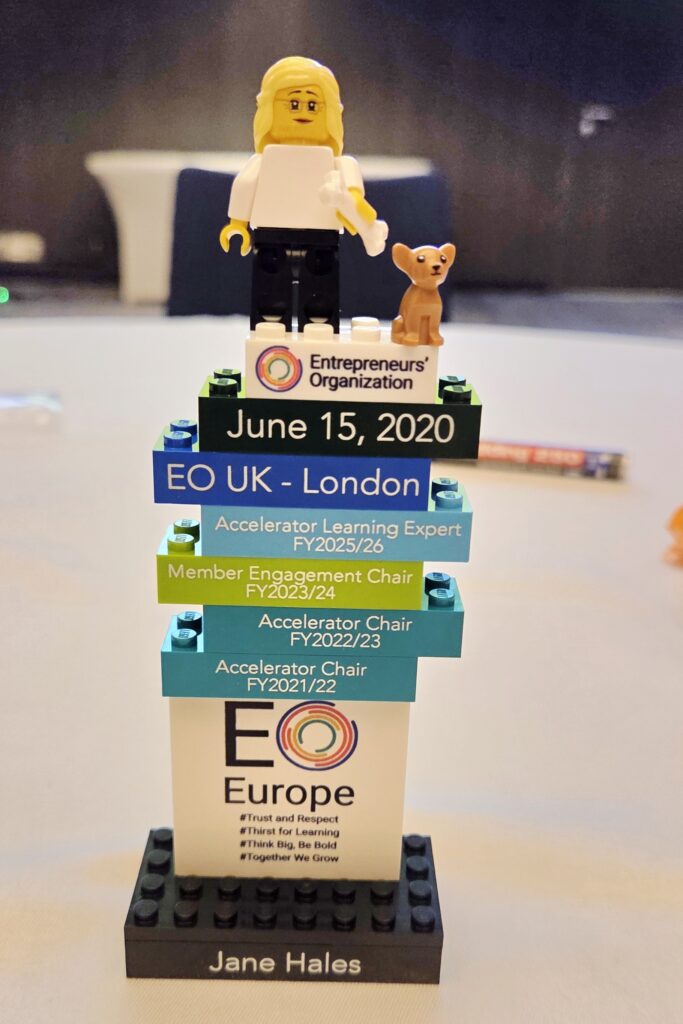
As Sapio matured, I gradually stepped back from day‑to‑day operations and into more explicit governance roles. I became a board director in my own company, then Vice Chair of Trustees in a Multi‑Academy Trust, in addition to my two decades tenure as a board member for a residential estate management company. Combined with this I took on leadership roles in Entrepreneurs’ Organization. Walking into a MAT board role and immediately being asked to sit on a senior exec appeal panel was a jolt. It brought home, in very human terms, how staff engagement, clear policies and robust systems directly affect people’s livelihoods, morale and trust.
These board roles gave me a new vantage point on the same patterns I had lived as a founder. Schools wrestling with growth and accountability. Property boards balancing cost, safety and community. Founders in Accelerator programmes struggling to get traction or scaling faster than their systems and relationships. Different sectors, same root issues: misalignment at the top, governance structures that haven’t kept pace with growth and a lack of safe, honest conversations between the people with the most to lose.
Influencing without authority
My voluntary work in Entrepreneurs’ Organization has been a notable chapter. Leading Accelerator programmes and serving as an European Expert meant getting founders to change behaviour, tighten governance and face uncomfortable truths when they did not “report” to me and could always walk away. I had to learn how to influence without authority, how to ask the hard question kindly and how to create spaces where founders could talk honestly about what was really going on at the top, while getting stuff done.
That same skill is at the heart of good Non‑Executive and Chair work, and it is also what many co‑founders secretly need from each other: the ability to challenge without shaming, to set boundaries without blowing up the relationship and to move forward without pretending everything is fine. Along the way, I discovered that wearing a Chair title does not magically equip anyone to handle co‑founder conflict. The ability to notice tension early, frame difficult conversations and support healthy evolution is a specialist skill set that many leaders – even experienced Chairpeople -complete their careers without ever really developing.
Back to my roots: researching co‑founders
After stepping away from full‑time operational leadership, I worked across various non‑competitive businesses. I appreciated the variety, but I missed my research roots. So I turned my attention back to what had always been running under the surface for me: the psychology of leaders and co‑founders, the processes that really hold a business together, facilitation, coaching and qualitative research.
I began interviewing co‑founders systematically – 100+ of them – across different sectors and stages. I listened to their stories of co‑founder discomfort, misalignment, loyalty, resentment, relief and repair. Some had near‑perfect partnerships, others were barely speaking, and most sat somewhere in between. Many even went back to co-found business again. From that work, I started to see patterns: the conditions that help co‑founders set up a healthy, profitable working relationship, and the habits that help them sustain it. I also saw where boards can struggle to support founders, especially around the complexities of relationship breakdown and exits.
This research ultimately became the foundation for my book, From Dream Team to Divorce?, which gives co‑founders and boards a practical language for what goes wrong – and what can still be repaired.
Why I now work with co‑founders
Today, my work sits at the intersection of all those experiences. I am a seasoned founder‑turned‑board member who still thinks like a researcher; I’ve stood down and I’ve watched a fellow cofounder exit. I now coach and advise CEOs and co‑founders through the messy middle of partnership, alignment and exit decisions. I design practical tools – like the ProfOps Success System, programmes, e‑books and courses – that help co‑founders put just enough structure around their business so they can scale without burning out or fracturing the relationship that started it all.
If you are a co‑founder searching for help with co‑founder conflict, misalignment, feeling “not on the same page”, or the quiet fear that your relationship might not survive the next phase of growth, my story is here for a reason. I have been in the trenches as a co‑founder, I have sat at the board table above the trenches, and I have researched and listened to countless other founding teams.
My goal is simple: to give you the language, frameworks and support you need to protect both your business and the relationship that built it and to make the next chapter easier than the last. If you are looking for a speaker or board‑level partner on co‑founder dynamics, governance or founder exits, this is the work I now do every day.
Feedback & Reviews
With gratitude I’ll share a little feedback
Mo Kanjilal
Cofounder, Edge of Difference
Richi Turner
Ops Director, Prevision Research
Pauline Bourcet
Managing Consultant, Frenger Consulting Services
What Can I Do for You?
Jane Hales works with scaling co‑founders (typically teams of 10–150) who feel the partnership is getting harder than the product. I offer a mix of speaking, advisory and confidential support so you can address conflict early, make clean decisions about roles or exits, and keep the business investable while you do it.